
01
An invisible mark
The photo looks the same. The mark adapts to each image, so it stays out of sight on smooth areas like sky and skin.
Every image you share carries a mark, woven into its pixels, behind what the eye can see. Not metadata. Not a logo in the corner. When a copy turns up where it shouldn’t, a scan names whose copy it was, even from a screenshot. For photographers and creators, and for every company whose images leave the building.
Each person you send a photo to gets their own copy. To the eye they’re identical. To a scan, each one names who it was issued to.
Four things working together, from the moment you upload to the moment you scan.
The photo looks the same. The mark adapts to each image, so it stays out of sight on smooth areas like sky and skin.
Each person gets their own version. If one leaks, the scan names the copy it came from.
A cropped screenshot or a phone photo of a screen is often all you find. The scan reads the mark from that too.
Every scan gives you a plain record: whose image it is, whose copy it was, when it was issued and where it surfaced. Written to be put in front of a client, a partner, a lawyer or a court.
Most of what the market calls a watermark is one of three things, and each of them is gone in minutes with tools anyone has. That is not a weakness of the people using them; it is how those marks are built.
A logo or text over the image. Cropped out, or removed with a generative fill in seconds. And the image is spoiled for everyone, including the client it was meant for.
EXIF, IPTC, XMP, C2PA. Stripped by every screenshot, every upload to a social network, every re-save. A signature proves a file is intact; it says nothing once the file has been copied.
A single pattern hidden in the image’s frequencies. Breaks under rotation, crop and rescale, and under the screenshot-of-a-screenshot chain; filters, re-encoding and AI tools that re-render texture finish the job. Often faintly visible on sky and skin.
No mark survives everything. The difference is what happens at the end of a real chain: screenshot, repost, phone photo, crop, filter, a partial AI edit. dipmark is built and tested for exactly that chain.
The mark is not attached to the file, a link or an account. It is part of the picture itself. Every copy anyone makes of your image carries it along, because copying the image means copying the pixels. The copy carries it without any server running. Nothing expires.
The mark in a copy does not fade or run out. There is nothing to renew and nothing in the file that can be switched off.
There is no metadata to delete and no logo to crop. The mark is where the picture is: in every pixel that is left.
Copies that left before you marked the image carry nothing, so mark before the first send. Every copy after that is covered.
The one thing that does not carry the mark is a new image: a scene redrawn from scratch rather than copied. Even then, dipmark still recognises that it was made from yours, and says so.
Stolen photos get screenshotted, reposted and re-shot off a monitor. dipmark is built to read the mark at the end of that chain.

Copy 03 · issued to [Client]. Three generations later, the copy still names its source.
The edits photos really go through, and what a scan returned afterwards in our tests. Of these, only a full AI redraw lost the mark.
The copy is identified: whose photo it is, and who it was issued to.
It’s your photo, but the mark is too damaged to say whose copy it was.
No mark and no match. We say so plainly, rather than guess.
In the lab you go through the real thing: we mark a copy with your name, you take it anywhere, and the scan reads your name back out of the pixels. Try it, try to break it, and decide for yourself.
Upload your photos. dipmark adds a mark that belongs to you and leaves the image as you made it.
Name the people you deliver to. Each one gets their own marked copy.
Found your photo where it shouldn’t be? Scan the copy you found. dipmark tells you whose photo it is and which copy it was.
 Cropped screenshot
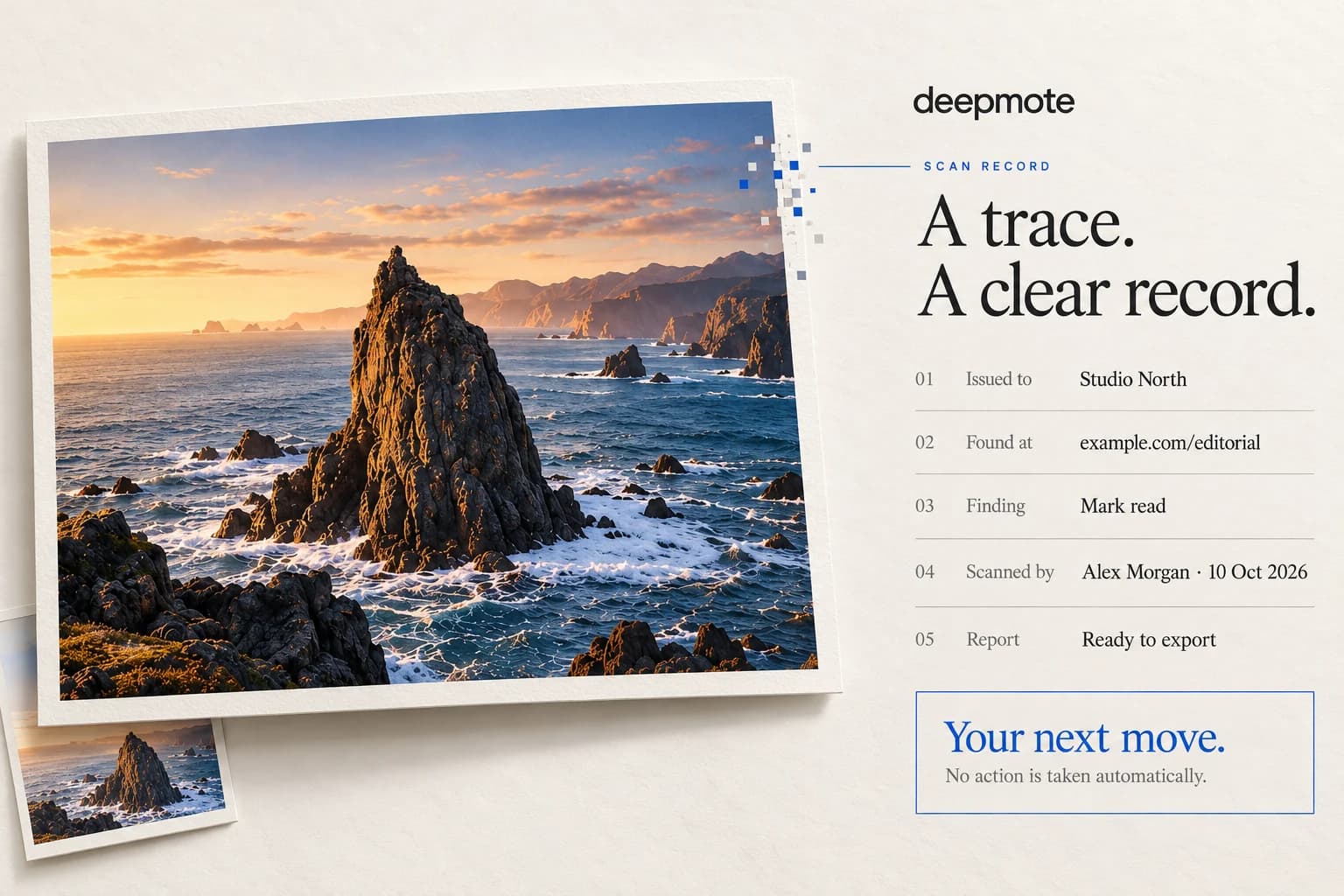
A scan doesn’t just say yes or no. It shows you what was found and leaves the next move to you.
The recipient the leaked copy was issued to.
The link or place you found it, kept with the scan.
Mark read, photo recognised, or nothing, stated plainly.
Who in your team ran which scan, and when.
A clean summary of the finding you can hand on.
You decide what happens next. dipmark never acts for you.
When it matters, nobody has to take our word for it. Three independent witnesses, each one checkable with open, standard tools.
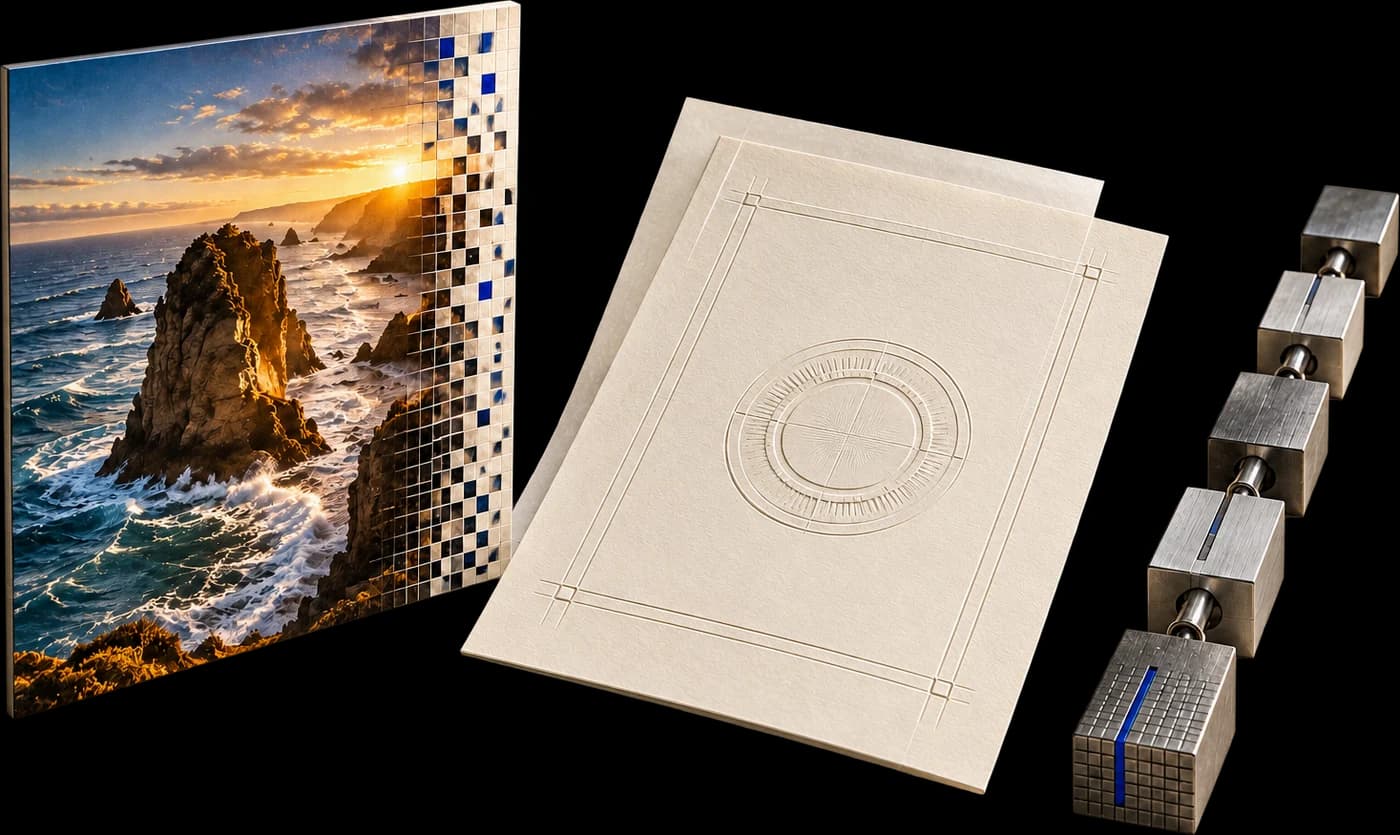
Read from the pixels of the copy that was found: which photo, and whose copy. Every finding says plainly what was read, and when a reading is less certain than usual.
Every registration is sealed within the hour by an independent timestamp authority, under the RFC 3161 standard. The seal proves when your photo was registered.
Switch it on and every registration is also recorded in the public Bitcoin blockchain. The proof outlives any company, dipmark included. No cryptocurrency or wallet involved.
For the timestamp and the Bitcoin anchor, only a fingerprint of each registration leaves dipmark, never your photos or your name. The proofs come as a download, ready for an expert, with the steps to check them.
Leaks rarely come from attacks. They come from the fourth person on a distribution list, a screenshot in a chat, a preview forwarded with good intentions. dipmark turns every shared image into an accountable copy: issued to a name, readable wherever it surfaces, documented when it matters.
When something leaks, you do not have to accuse a circle of people. The copy itself names the recipient it was issued to.
Recipients who know each copy is theirs treat it differently. The mark works before anything leaks.
Each scan is logged with the file, its fingerprint, the original and the time. One click turns it into a report written for a lawyer or a court.
Screenshots, reposts, phone photos of screens, crops, filters, partial AI edits. The mark is read at the end of that chain, not from the original file.
Recipients receive ordinary files. Nothing is sent to anyone, and no action is taken, without you.
Photographs, documents, renders, drawings, screenshots of designs. If it is an image file, it can be marked and traced.
Photographers and creators protect their work. Companies protect what they share before it is public: products, designs, documents, campaigns.
Know which client, editor, lab or follower a leaked image came from, and prove the repost is yours.
Every delivery from the team marked under one owner; every recipient their own copy. One leak, one name.
Launch imagery, packaging, renders and campaign material shared under embargo with partners, retailers and press.
Trace a copy back to the licence it was sent under, and to the outlet that broke the terms.
Confidential documents and evidence photos shared with a defined circle, with an audit trail built to be examined.
Plans, listings, prototypes and technical drawings that must reach three people and stay with those three.

Previews sent to the couple and two vendors. One shows up online early. The scan names the copy.

Your photo, cropped and filtered, on someone else’s feed. The scan shows it’s yours.

A pitch went to three people. A rival had it a week later. Now you know which one.
Not to the eye. The mark adapts to each image and stays out of sight on smooth areas like sky and skin.
We’re working with a small group of photographers, studios, agencies and companies that share sensitive images. Tell us what you share, and we will open an account for you.